From Oracle Bones to Hanja: Why Chinese Characters Have Different Forms
An old inscription and a modern phone keyboard can belong to the same writing tradition without using the same-looking forms. The history is more interesting than a straight line from complicated to simple.
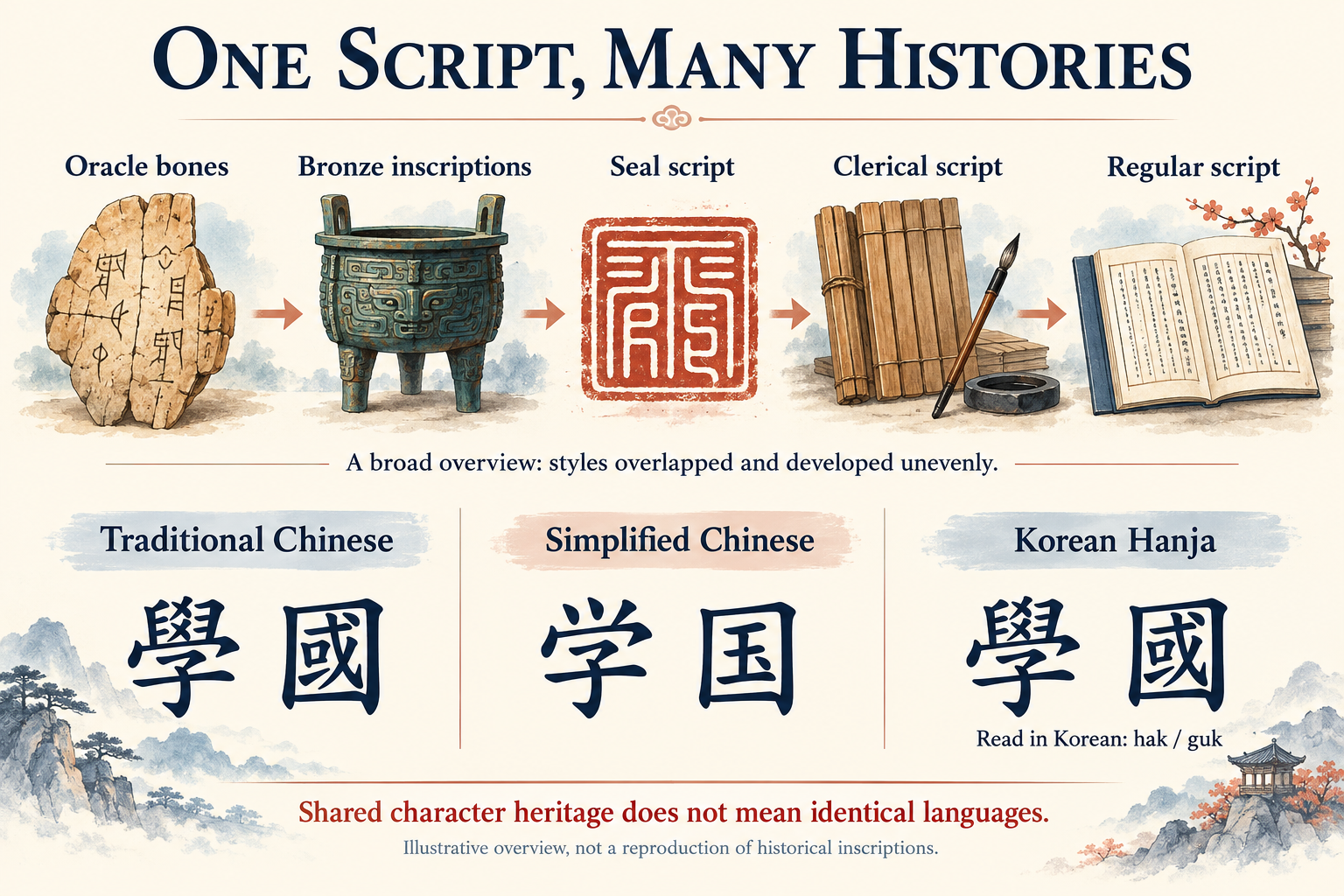
Before there were printed characters
Chinese writing has a long history of changing materials, shapes and conventions. Surviving Shang-period oracle-bone inscriptions are an important early source. Bronze inscriptions, seal styles, clerical writing and regular script belong to the wider story. This is a broad overview, not a claim that every character passed through five identical steps. Styles overlapped, and older styles remained useful in artistic and formal settings.
Changing a writing style is not the same as changing a spelling standard
Carving on a hard surface and writing with a brush create different practical demands. As scribal practices developed, character shapes and stroke conventions also changed. Modern calligraphers can still use seal, clerical, cursive, semicursive and standard styles. A character written in a calligraphic style is not automatically a simplified character; style and the officially preferred written form are different questions.
Why traditional and simplified forms differ
Mainland China adopted a major character-simplification scheme in 1956, followed by a consolidated list in 1964. This was part of a broader program of writing reform and education. Simplification involved changing selected forms and components; it did not replace every character with a new one. Traditional forms remain standard in places including Taiwan and Hong Kong, while simplified forms are widely used in mainland China and Singapore. These are writing conventions, not a ranking of languages or cultures.
A small comparison that makes the difference visible
For learning, compare 學 and 学, or 國 and 国. Each pair illustrates traditional and simplified forms, but many characters do not differ between the two conventions. Converting a whole text is not always a simple one-character swap: variant relationships and usage can require context. The safest learning habit is to study the word in a sentence, its pronunciation and the form appropriate to the material you are reading.
Where Korean Hanja fits
Hanja refers to Han characters used in Korean. Korean Hanja generally follows traditional-type forms, with its own typographic conventions and Korean readings. 學 is read hak and 國 is read guk in Sino-Korean usage. Those readings are not Mandarin pronunciations. Shared character heritage therefore does not mean that a Korean text is Chinese, or that knowing one language automatically lets you read the other.
Hanja and Hangul are different systems
Hangul is an alphabet whose letters are arranged into syllable blocks. Hanja characters are a different writing system. Modern Korean is predominantly written in Hangul, while Hanja can still appear in names, historical materials and explanatory contexts. A word with Sino-Korean roots can be written in Hangul; the origin of the vocabulary and the script visible on the page are separate facts.
A useful way to explore the history
Start with one familiar word rather than memorizing a large chart of isolated forms. Note its meaning, pronunciation, traditional form and simplified form; add a Korean reading only when that is relevant. Then compare real examples in context. The illustration here is an AI-generated educational overview, not a reproduction of an ancient inscription or a precise reconstruction of historical glyphs.
Sources
The Met — major calligraphic script types
China Ministry of Education — 1956 and 1964 reforms
Unicode — Han characters and regional conventions